
Hire Employees in Kiribati
2026 EOR, Payroll and Employment Guide
One contribution only: 7.5% to the Provident Fund, matched by the employee. The catch is the wage floor, overseas-funded projects pay A$3.00 an hour against A$1.30 for local businesses, and an EOR client is almost always in the higher tier.
This guide covers Kiribati Provident Fund contributions and membership rules, the dual-tier minimum wage, PAYE at 25% to 35%, enforcement powers under the Employment and Industrial Relations Code 2015 and compliance risk for hiring in Kiribati in 2026. Verified on 26 August 2026 against the KPF.
Can a foreign company hire employees in Kiribati?
A foreign company can employ through a local entity or an Employer of Record. The Provident Fund is the only compulsory scheme, and salaries are paid in Australian dollars.
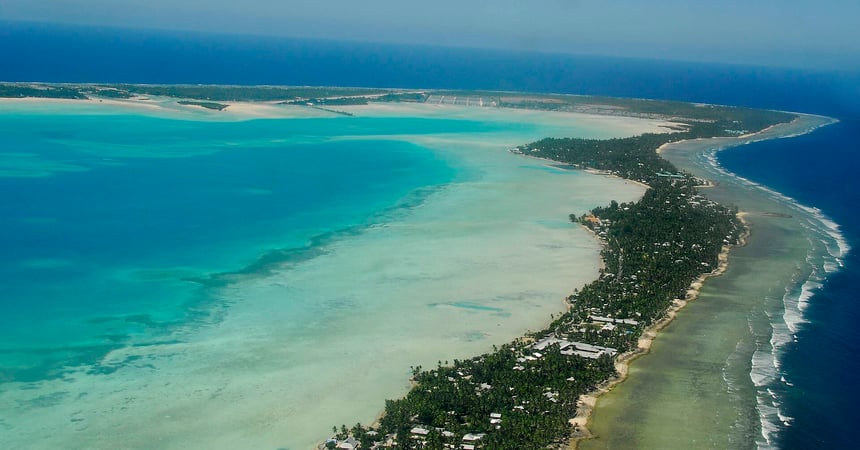
Kiribati is a Pacific republic spread across three island groups and straddling both the equator and the date line. It uses the Australian dollar.
Two routes exist. A local entity gives direct employment; an Employer of Record removes that setup and acts as legal employer.
The Kiribati Provident Fund is the only compulsory social contribution. There is no statutory unemployment insurance, disability insurance or public healthcare scheme funded by payroll tax, so the 7.5% is genuinely the whole of the mandatory employer cost.
Employment is governed by the Employment and Industrial Relations Code 2015, which requires written contracts for permanent, fixed-term and trainee staff alike.
Sources: GX Country Intelligence researchGX operating experience. Kiribati EOR payrollverified 26 August 2026
EOR, entity or contractor, which model fits?
7.5% of earnings, matched by the employee. It is the only compulsory employer contribution, there is no separate health, unemployment or injury levy.
Employer contributions are 7.5%, and nothing else is mandatory.
The KPF expresses it precisely: the contribution rate is 7.5 cents in respect of each complete dollar earned, with the employer contributing at the same rate, totalling 15 cents. Contributions are calculated in respect of total earnings.
The Fund’s own worked example runs on a fortnightly cycle: on a basic wage of $120, the employee share is $9.00, the employer share is $9.00, and the combined 15% is $18.00, with the employer remitting $36.00 across the month and reporting full details on a monthly schedule.
Employer contributions are not withheld from wages; they are a separate employer cost.
| Employer of Record | Local business tier | Overseas-funded tier | |
|---|---|---|---|
| Time to first hire | 4–8 weeks | 3–6 months via own entity | Same |
| Minimum wage | Depends on funding source | A$1.30 an hour | A$3.00 an hour |
| Monthly equivalent | A$225 or A$520 | About A$225 | About A$520 |
| Provident Fund | 7.5% employer | 7.5% employer | 7.5% employer |
| Misclassification risk | Low, statutory employment | Low, statutory employment | High, back pay plus 10% interest can be ordered run the risk check |
| Best for | First 1–12 hires, market entry | Locally funded work | Donor and development projects |
Break-even rule of thumb: EOR fees begin to exceed the running cost of a local entity somewhere between 12 and 20 employees. See EOR vs Entity.
Sources: ISSA country profile - KiribatiGX Country Intelligence researchGX operating experience. Kiribati EOR payrollverified 26 August 2026
How Employer of Record hiring works in Kiribati
How much does it cost to employ someone in Kiribati?
Membership is broad: anyone aged 14 or over earning at least $10 a month, under a contract that may be oral or merely implied.
Membership is defined more broadly than most schemes, and the definition catches informal arrangements.
An employee is anyone who has attained 14 years of age, earns wages of at least $10 a month, and is employed in Kiribati under a contract of service or employment or apprenticeship, whether written or oral, and whether expressed or implied.
That last phrase matters. An arrangement never reduced to writing, or never formally agreed at all, can still create a contribution obligation. There is no minimum hours test and the earnings threshold of $10 a month is nominal.
The exemptions are narrow and specific: any domestic servant, any person under the age of 14, and any person detained in a mental hospital or in a prison for a term of imprisonment.
Domestic servants being excluded is worth noting, the treatment varies sharply across comparable jurisdictions, and household staff engaged locally fall outside the fund here.
Self-employed workers may join the scheme voluntarily.
Sources: Kiribati Provident Fund. MembersEmployer contribution schedule 2026verified 26 August 2026
2026 mandatory employer contributions
| Contribution | Total rate | Employer share | 2026 cap | Effective cost |
|---|---|---|---|---|
| Provident Fund, employer | 7.5% | 100% employer | No ceiling | Per complete dollar earned |
| Provident Fund, employee | 7.5% | 100% employee | No ceiling | Deducted from pay |
| Combined rate | 15% | Employer and employee | No ceiling | Remitted together monthly |
| Contribution base | Total earnings | Both sides | No ceiling | Overtime and allowances included |
| Employer share treatment | Separate cost | Not withheld | Never deducted from wages | |
| Other payroll levies | None | No health, unemployment or injury levy | ||
| Minimum wage, local | A$1.30/hour | Local businesses | About A$225 a month | |
| Minimum wage, overseas | A$3.00/hour | Overseas-funded projects | About A$520 a month | |
| PAYE | 25%–35% | 100% employee | Flat 30% non-resident | Confirm with Inland Revenue |
| Total mandatory employer cost | 7.5% | No ceiling | The only compulsory contribution |
Worked example
| Gross annual salary A$24,000 | A$2,000 a month |
| Provident Fund employer at 7.5% | A$1,800 |
| Employee contributes 7.5% | A$1,800 |
| Combined into the member account | A$3,600 a year |
| No other employer levy applies | Nothing further is due |
| PAYE on the employee | From 25% on resident income |
| Total employer cost | A$25,800 · 7.5% above gross |
Kiribati employer-cost calculator
Enter a gross monthly salary to see the breakdown.
What does a real hire cost? Benchmarks by role
Gross annual salaries in Australian dollars. Employer cost is a flat 7.5% with no ceiling.
Benchmarks below are gross annual salaries in Australian dollars, which Kiribati uses as its currency. Employer cost is a flat 7.5% with no ceiling.
Sources: ILO EPLex - KiribatiKiribati salary survey data 2026Minimum wage arithmetic noteverified 26 August 2026
How Kiribati compares & employer on-costs in the region
Indicative 2026 statutory employer rates on typical professional salaries, before benefits and 13th-month customs. Full country data: hiring in Palauhiring in Marshall Islands.
How do payroll, income tax and the 13th month work?
Monthly, with both shares remitted together on a monthly schedule and detailed payslips required for every pay period.
Payroll runs monthly, with both contribution shares remitted together and reported on a monthly schedule.
Employers must maintain thorough payslips detailing gross pay, deductions, net pay, leave taken and overtime, and provide a written pay statement for every pay period.
PAYE is withheld and remitted separately to the Tarawa Tax Office.
Given the country’s remoteness and limited administrative infrastructure, build in more lead time for registration and remittance than a comparable market would need.
Sources: verified 26 August 2026
2026 resident income tax brackets
Reported at 25%, 30% and 35% for residents and a flat 30% for non-residents, but confirm current thresholds with Inland Revenue.
Income tax is collected through PAYE, with reported progressive rates of 25%, 30% and 35% for residents and a flat 30% for non-residents.
Note the starting point. A lowest band of 25% is high by regional standards, so net pay is materially lower than a gross figure suggests, worth explaining when comparing an offer against another Pacific market.
Confirm the current brackets and thresholds directly with the Kiribati Inland Revenue Division at the Ministry of Finance. Exact figures are not reliably published internationally, and providers themselves flag them as requiring local verification.
| Band | Rate |
|---|---|
| Resident PAYE | Reported at 25%, 30% and 35% |
| Non-residents | Flat 30% |
| Verification | Confirm with the Inland Revenue Division |
| Lowest band | 25%, high by regional standards |
| Remittance | To the Tarawa Tax Office |
Resident rates run 25% to 35%. Non-residents are taxed at a flat 30%.
What does Kiribatiese labor law require?
Two floors apply. Local businesses pay A$1.30 an hour; overseas-funded projects pay A$3.00, the tier depends on who funds the work.
Kiribati does not have a single minimum wage. It has two, and which applies depends on who is funding the work rather than what the work is.
As of January 2026, workers in local businesses earn AUD 1.30 an hour, roughly USD 0.87. Workers on overseas-funded projects receive AUD 3.00 an hour, about USD 2.00.
On a 40-hour week that is approximately A$225 a month for local roles against A$520 for international projects, more than double either way.
Treat published monthly equivalents with care. Provider guidance quotes A$450 and A$1,038, but those figures only reconcile with the hourly rates at about eighty hours a week. The hourly rates are the statutory measure; derive the monthly figure from them rather than the other way round.
For a foreign employer this is the single most important number on the page. An EOR engagement funded from overseas will normally fall in the higher tier, so a cost model built on the local floor understates wages by well over a hundred per cent.
Both rates are set by government and enforced under the Employment and Industrial Relations Code 2015. For context, GDP per capita sits at around USD 1,400 to 2,500.
Sources: ILO EPLex - KiribatiILO EPLex - Kiribativerified 26 August 2026
Contracts & probation
All employees should have written contracts under the Employment and Industrial Relations Code 2015, covering permanent, fixed-term and trainee staff.
Establish the funding source of the role at contracting stage, since it determines the applicable wage floor.
Note that an oral or implied arrangement still creates Provident Fund liability, so a written contract protects the record rather than creating the obligation.
Working hours & overtime
Contributions are calculated on total earnings, so overtime and allowances enter the base.
The 7.5 cents applies to each complete dollar earned, so the calculation works on whole dollars rather than fractions.
Overtime must be recorded on the payslip alongside gross pay, deductions, net pay and leave taken.
Annual leave
| Tenure | Paid annual leave |
|---|---|
| Working week | 40 hours across 8-hour days |
| Minimum wage, local | A$1.30 an hour |
| Minimum wage, overseas-funded | A$3.00 an hour |
| Contribution deadline | By the 15th of the month |
| Written contracts | Required for all staff |
| Public holidays | Around 23 in 2026 |
Public holidays
Kiribati observes a large number of public holidays, including a multi-day Independence celebration in July and Youth Day in August. Around 23 public holidays fall in 2026.
Kiribati observes a large number of public holidays, including a multi-day Independence celebration in July and Youth Day in August.
| Holiday | Date (2026) |
|---|---|
| New Year’s Day | Thu 1 Jan |
| Good Friday | Fri 3 Apr |
| Easter Monday | Mon 6 Apr |
| National Health Day | Wed 8 Apr |
| Gospel Day | Sat 11 Jul |
| Independence Day | Sun 12 Jul |
| Independence Day holiday | Mon 13 Jul |
| Youth Day | Tue 4 Aug |
| Te Runga | Wed 5 Aug |
| Human Rights Day | Thu 10 Dec |
| Christmas Day | Fri 25 Dec |
| Boxing Day | Sat 26 Dec |
Family & sick leave
It is a provident fund, not a pension. Contributions sit in an individual account and are paid out as a balance rather than an income entitlement.
The KPF is a provident fund, not a pension scheme, and the distinction is real.
Each employee’s contributions are held in an individual account, and the accumulated balance is paid out on retirement, on permanent departure from Kiribati, or on certain other qualifying events. Members may nominate someone to receive their benefits on death.
There is no pooling and no defined benefit, what the employee gets is what was paid in, plus earnings.
A separate, non-contributory old-age pension exists for citizens aged 67 and over, paying a flat rate set by the government budget, usually around $50 a month, or $60 for those over 70. It is funded from general revenue rather than payroll.
Healthcare is not covered by payroll at all. Public provision is limited, and expatriates typically need medical evacuation insurance to Fiji or Australia for serious conditions. Housing allowances are very common, particularly in South Tarawa where supply is short and on the outer islands.
Bereavement, jury duty and voting leave are not mandated by statute.
| Leave | Entitlement | Pay |
|---|---|---|
| Provident fund model | Individual accounts | No pooling, no defined benefit |
| Payout triggers | Retirement or permanent departure | Plus other qualifying events |
| Death nomination | Member names a beneficiary | Recorded with the fund |
| Old-age pension | Non-contributory, age 67 plus | About $50 a month, $60 over 70 |
| Healthcare | Not funded by payroll | Public provision is limited |
| Medical evacuation | Common for expatriates | To Fiji or Australia |
| Housing allowance | Very common in practice | Supply is short in South Tarawa |
| Unmandated leave | Bereavement, jury duty, voting | Contractual only |
| Voluntary membership | Open to the self-employed | Contributions are capped |
Termination, notice & severance
Termination follows the Employment and Industrial Relations Code 2015.
Enforcement has teeth. The Ministry of Labour and Human Resource Development investigates complaints and can order full back pay plus 10% interest owed to workers.
Repeat violations may incur double fines or imprisonment for company directors, personal exposure that is unusual at this scale of economy and worth flagging to anyone signing off on local compliance.
Permanent departure from Kiribati is a qualifying event for release of the Provident Fund balance.
How do work permits and visas work in Kiribati?
Salaries are paid in Australian dollars, so there is no local currency risk for an AUD-denominated employer.
Expatriate packages commonly include housing and medical evacuation cover, both of which are practical necessities rather than perks.
Confirm work authorisation before committing to a start date, and allow extra time for administration given the country’s remoteness.
| Route | Who it fits | Key criteria | Notes |
|---|---|---|---|
| Work authorisation | Foreign nationals | Confirm before the start date | Allow extra lead time |
| Currency | All employers | Australian dollar | No local currency risk |
| Remoteness | All employers | Limited administrative capacity | Build in longer timelines |
Sources: ILO EPLex - Kiribativerified 26 August 2026
What are the main compliance risks when hiring in Kiribati?
Applying the local A$1.30 floor to an overseas-funded role is the costliest error, and the one a foreign employer is most likely to make.
Applying the local A$1.30 floor to an overseas-funded role is the costliest error, and the one a foreign employer is most likely to make. The correct floor is more than double.
Assuming an informal arrangement escapes the Provident Fund is the second, membership catches contracts that are oral or merely implied.
Underestimating income tax is the third. The lowest reported resident band is 25%, so net pay is well below what a gross figure suggests.
Note also that domestic servants are exempt from the fund; that enforcement can reach directors personally on repeat violations; and that healthcare sits entirely outside payroll.
Sources: ISSA country profile - KiribatiGX Country Intelligence researchISSA country profile - Kiribativerified 26 August 2026
Contractor misclassification risk check
Answer for the Kiribati-based person you currently pay as a contractor. Indicative only — not legal advice.
Compliant onboarding checklist
Establish whether the role is locally or overseas funded, and apply the matching wage floor, it is the difference between A$1.30 and A$3.00 an hour.
Register every worker with the KPF, including informal arrangements, and remit both shares monthly with full reporting.
Confirm PAYE brackets with Inland Revenue, and budget separately for housing and medical evacuation cover, which payroll does not touch.
Hiring in Kiribati & frequently asked questions
The full 2026 Kiribati hiring guide — rates, tables and checklists — formatted for sharing with your finance and legal teams.
Sources: verified 26 August 2026
Terms used on this page
Sources: verified 26 August 2026
How this guide is compiled and verified
Every figure is taken from the primary Kiribati government source, checked against GX’s in-country payroll operation, and dated. This guide was last reviewed on 26 August 2026, and is next scheduled for review in November 2026 — or immediately if rates change in between.
- Kiribati Provident Fund. Members — The 7.5 cents contribution rate, membership definition and exemptions · verified 26 Aug 2026
- Kiribati Provident Fund. FAQ — The worked contribution example and monthly reporting schedule · verified 26 Aug 2026
- Kiribati Provident Fund — Contribution calculation on total earnings and death nominations · verified 26 Aug 2026
- ILO EPLex - Kiribati — The dual-tier minimum wage and enforcement powers · verified 26 Aug 2026
- ILO EPLex - Kiribati — Employer obligations, unmandated leave and public holidays · verified 26 Aug 2026
- ILO EPLex - Kiribati — PAYE rates, the provident fund model and written contract requirements · verified 26 Aug 2026
- ISSA country profile - Kiribati — The absence of a traditional social security system · verified 26 Aug 2026
- ILO EPLex - Kiribati — The old-age pension and voluntary self-employed membership · verified 26 Aug 2026
- GX Country Intelligence research — Housing and medical evacuation practice, and currency · verified 26 Aug 2026
- ILO EPLex - Kiribati — The statutory basis for contracts and wage enforcement · verified 26 Aug 2026
- GX Country Intelligence research — Verification of current PAYE rates and thresholds · verified 26 Aug 2026
- ISSA country profile - Kiribati — Complaint investigation and back pay orders · verified 26 Aug 2026
- GX operating experience. Kiribati EOR payroll — Onboarding timelines, EOR fee structure and practical employer obligations observed in live payrolls · verified 26 Aug 2026
- Kiribati salary survey data 2026 — Indicative gross annual earnings used for role benchmarks · verified 26 Aug 2026
- Kiribati public holiday calendar 2026 — Public holidays including Independence Day and Youth Day · verified 26 Aug 2026
- Employer contribution schedule 2026 — The 7.5% rate applied in the cost calculator · verified 26 Aug 2026
- Minimum wage arithmetic note — Reconciliation of hourly rates against published monthly equivalents · verified 26 Aug 2026
Read our editorial policy, corrections policy and CountryPedia methodology.
Sources: verified 26 August 2026
Ready to hire in Kiribati?
GX employs your candidates compliantly, contract, Australian dollar payroll, KPF registration and monthly remittance handled, with the right minimum wage tier applied.